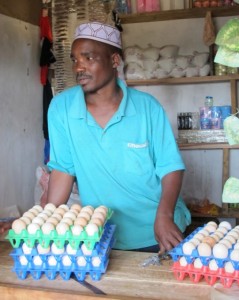
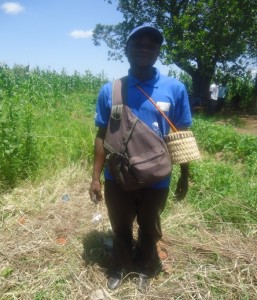
Pedro Filipe Real Bande
Community Vaccinator
MOZAMBIQUE
“For the March 2015 vaccination campaign, even before starting the vaccination, there were already 114 families who requested the vaccination of their chickens and I did vaccinate 2,243 chickens and everyone paid for the vaccination.”
My name is Pedro Filipe Real Bande, I am from Sussendenga district in Manica province. In 2012, I was selected and trained as a community vaccinator for the control of Newcastle disease in village chickens. At that time, the training was based on the use of Ita-New vaccine, which is administered through intramuscular injection. After the training I started the vaccination activity in Sussendenga, but in 2013 I moved to another community called Zixixe but still in Sussundenga district. Here, I continued with the chickens’ vaccination activity. In June 2014, we were told that we would no longer use Ita-New and received training to start using I-2 vaccine. As this was a new vaccine, for the first vaccination campaign (July 2014) the communities were reluctant to provide their chickens to be vaccinated. Out of the 350 families in the community, only 24 accepted to vaccinate their chickens. But as I was always vaccinating my chickens, the mortality almost disappeared and the number of chickens increased a lot. Because before the vaccination my chickens usually died, when I started to vaccinate them in 2013, I had only 29 chickens and in November 2014 I had 374 chickens and my selling’s, also increased. In December 2014, I was able to sell 80 chickens and earned about 12.000, 00 meticais (mts). My neighbours started asking why my chickens were so productive; why the chicks did not die; how could I manage to sell so many chickens and still remain with a big number. In response I only told them that I vaccinate my chickens regularly for them not being attacked by Xigubo-gubo disease. I also feed the chickens with maize husk. When I don´t have enough maize husk at home, I buy in the local market, 1 bag of 100 kgs costs 200.00 mts. As we were also taught how to build poultry houses using local materials I keep the chickens in this house. Besides chickens I also raise cattle (27 cows), 12 goats and I grow some crops for my family. Apparently after seeing the number of my chickens increasing, my neighbours got convinced about the efficacy of this vaccine.