
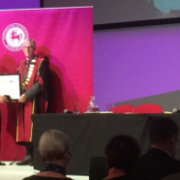
Recently at the Australian Veterinary Association (AVA) conference in Adelaide, one of KYEEMA’s long associates, Associate Professor Joanne Meers was awarded the prestigious Kesteven Medal for her contributions to international veterinary science.
Associate Professor Meers has provided technical support for KYEEMA’s work on promoting the benefits of thermotolerant Newcastle disease vaccine for chickens of smallholder farmers. She also manages the I-2 Vaccine Master Seed storage and dispatch through the University of Queensland School of Veterinary Science.
“Dr Meers provides a wonderful example of a highly motivated, highly skilled veterinarian who brings a remarkable capacity to use high level skills in the training and upskilling of colleagues in the developing world. She combines excellence as a veterinary virologist with a personal warmth and kindness that her colleagues across diverse cultures recognise and appreciate. When these technical and personal skills are then supplemented by the professional leadership skills of Dr Meers, the final combination is a unique person.” From AVA Award Citation.
It is people like Joanne that enable KYEEMA to achieve positive animal and human health outcomes in our project communities. We are proud and immensely thankful for Jo’s continued support of and association with KYEEMA.



With the release of the UN sustainable development goals this year, it is timely to reflect on the story of the KYEEMA Foundation and how our work, made possible with the help of Australian Aid funding, will contribute to the revised international vision for development leading to 2030.
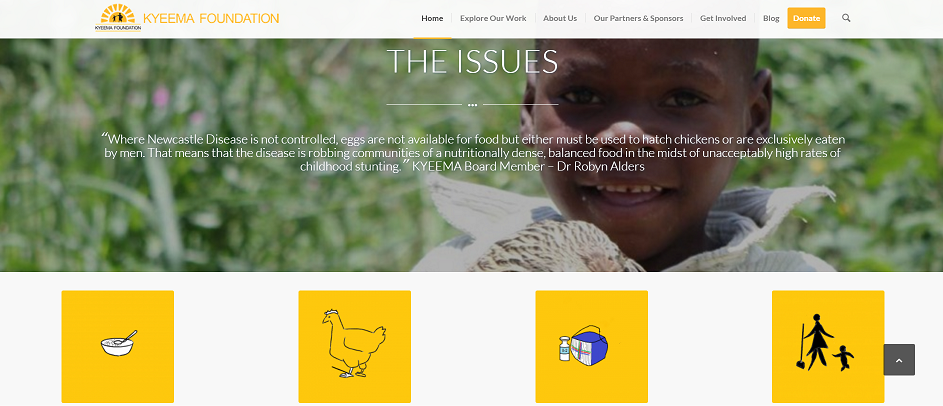
KYEEMA Foundation, and its subsidiary the International Rural Poultry Centre (IRPC), have been operating for 11 years now. Our original website was developed in 2005 and in the past 10 years, technology has changed dramatically. So it is definitely time to launch a new look! The new website is located at: www.kyeemafoundation.org. Thanks go to the website designers Julie Fairless and Paolo Curray for their patience in finalising this website and for their beautiful layout.
While the human health community pays considerable attention to cold chain issues, the animal health cold chain receives much less attention. Fortunately, the Australian Centre for International Agricultural Research (ACIAR) has provided funding for KYEEMA, in collaboration with the University of Sydney, to develop and print a Cold Chain manual for veterinary vaccines in both English and French, which is now being prepared for printing.
Vaccines are a key component of animal disease prevention and control worldwide. They have a major role in protecting animal and public health, reducing animal suffering, enabling efficient production of food animals, and greatly reducing the need for antibiotics to treat food and companion animals. However, these important activities can be seriously compromised by poor vaccine storage and handling.
This manual covers aspects of storage and transport of veterinary vaccines: the equipment used, monitoring the cold chain, how to recognise and deal with breaches of the cold chain, and packing vaccines. It will support effective distribution of the I-2 Newcastle disease (ND) vaccine and will enhance local capacity to store and handle vaccines effectively, leading to better nutritional, livelihood and environmental outcomes for those living in poverty.
All countries interested in improving the storage and transport of animal vaccines, including those currently producing or wishing to produce I-2 vaccine for the control of ND in village chicken populations, will benefit from the use of this manual. The final printed and online versions will be ready for distribution in early 2016.
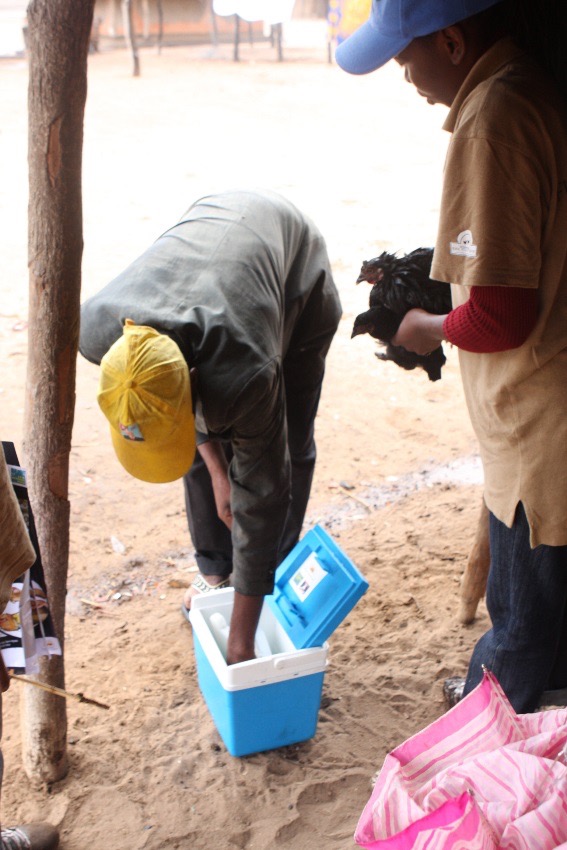
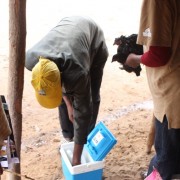
Community vaccinator taking vaccine from cooler box prior to vaccinating chickens