• Link to Facebook
  • Link to LinkedIn
  • Link to Instagram
  • Link to Youtube
Kyeema Foundation
  • Home
  • About us
    • Our team
    • Our history
    • Our partners
    • Strategic Plan 2021-2026
    • Annual Report
  • Explore our work
    • Country Programs
      • Ethiopia
      • Malawi
      • Mozambique
      • Papua New Guinea
      • African Union
    • Funds for Impact
      • Challenge Fund
      • Our Communities Fund
      • Humanitarian Relief Fund
  • Resources
  • What’s New
  • Get Involved
  • Leave a legacy
  • Donate
  • Click to open the search input field Click to open the search input field Search
  • Menu Menu
KYEEMA World Day Combat Desertification

The Chicken Advantage: KYEEMA reflects on World Day to Combat Desertification

July 3, 2016/in Impact/by Eliza Smith

On Friday 17 June, the United Nations held World Day to Combat Desertification. The theme this year is ‘Inclusive cooperation for achieving Land Degradation Neutrality’.

“There is probably no greater issue than land in the post-2015 Sustainable Development Goals that touches everyone. From the food we eat, to the clothes we wear and the houses we live in – it all stems from land resources. In order to “leave no one behind” as proclaimed in the new Sustainable Development Goals, achieving land degradation neutrality needs to be in the forefront to meet our requirements and develop sustainability.” Read more.

Protect Earth. Restore Land. Engage People

This is the challenge for the world’s marginal drylands where there are fragile ecosystems due to harsh climatic conditions and growing human pressures – they are occupied by the poorest of the poor who rely on farming, pastoralism and natural resource utilisation.

KYEEMA works in these places, with these people and recognises the importance of sustainable livestock for sustainable lives here.

There is much that can be done to manage and use livestock to improve land, health and livelihoods in these areas:

  1. Appropriate improvements to feeds, breeds and animal health to increase meat, milk and egg yields in resource poor settings.
  2. Maintain healthy ecosystems and regenerate degraded lands through agroforestry and eco-conservancies that promote better animal management practices, biodiversity conservation and farmer managed natural revegetation.
  3. Using manure as renewable energy, in soil regeneration programs and as natural fertiliser for crops.

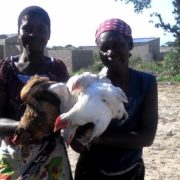
Village poultry production is a flexible production system that can be adapted to many different agro-ecological zones.

From ‘The Comparative Advantages of village or smallholder poultry in rural development’ by Alders and Copland in ACIAR Proceedings 13: Village Chickens, Poverty Alleviation and the sustainable control of Newcastle disease (2009) p. 11

This is because it:

  1. Requires low input – in many places it is an existing resource whose output can be increased with modest input.
  2. Has low to no environment impact – compared to commercial birds and ruminants, village poultry are more environmentally neutral.
  3. Is robust and agile – village poultry are better survivors in natural disasters and degraded landscapes. They are more easily transported in times of socio-political unrest. In uncertain times they provide a mobile and hardy source of nutrition for vulnerable communities.
  4. May provide an innovative sustainable alternative to traditional pastoral species in degraded landscapes in some parts of the world.
Tags: buildtheflock, Livestock4Dev, World Day Combat Desertification
Share this entry
  • Share on Facebook
  • Share on X
  • Share on WhatsApp
  • Share by Mail
https://kyeemafoundation.org/wp-content/uploads/2016/07/Protect-Earth-Restore-Land-Engage-People..png 468 583 Eliza Smith https://kyeemafoundation.org/wp-content/uploads/2022/07/Kyeema-Foundation-logo-400w-resize.png Eliza Smith2016-07-03 13:53:482016-10-27 13:26:52The Chicken Advantage: KYEEMA reflects on World Day to Combat Desertification
You might also like
KYEEMA Board members KYEEMA welcomes new Board members
kyeemaindigenousday2016 Recognising Indigenous Rights, Knowledge, Resources and Chickens for Sustainable Livelihoods
KYEEMA Veterinary Cold Chain Robyn Alders launches Veterinary Cold Chain Manual at Agriculture, Nutrition and Health Academy Week in Addis Ababa
Jo Meers KYEEMA Associate Professor Joanne Meers recognised for Animal Health work in Developing Communities
Pat Boland KYEEMA A word from our partner in Malawi on International World Youth Skills Day
KYEEMA C4AA Make your tax time donation count for more people like Camillo
Jospehine Clapham KYEEMA Meet our volunteer in Kiribati
Australian Festival of African Film Brisbane launch on 12th May 2018
Search Search
© Copyright – 2020 Kyeema Foundation
  • Link to Facebook
  • Link to LinkedIn
  • Link to Instagram
  • Link to Youtube
  • Media
  • Blog
  • What’s New
  • Annual reports
  • Resources
  • Projects
  • Policies
  • Contact us
Link to: Robyn Alders launches Veterinary Cold Chain Manual at Agriculture, Nutrition and Health Academy Week in Addis Ababa Link to: Robyn Alders launches Veterinary Cold Chain Manual at Agriculture, Nutrition and Health Academy Week in Addis Ababa Robyn Alders launches Veterinary Cold Chain Manual at Agriculture, Nutrition...KYEEMA Veterinary Cold Chain Link to: Associate Professor Joanne Meers recognised for Animal Health work in Developing Communities Link to: Associate Professor Joanne Meers recognised for Animal Health work in Developing Communities Jo Meers KYEEMAAssociate Professor Joanne Meers recognised for Animal Health work in Developing...
Scroll to top Scroll to top Scroll to top